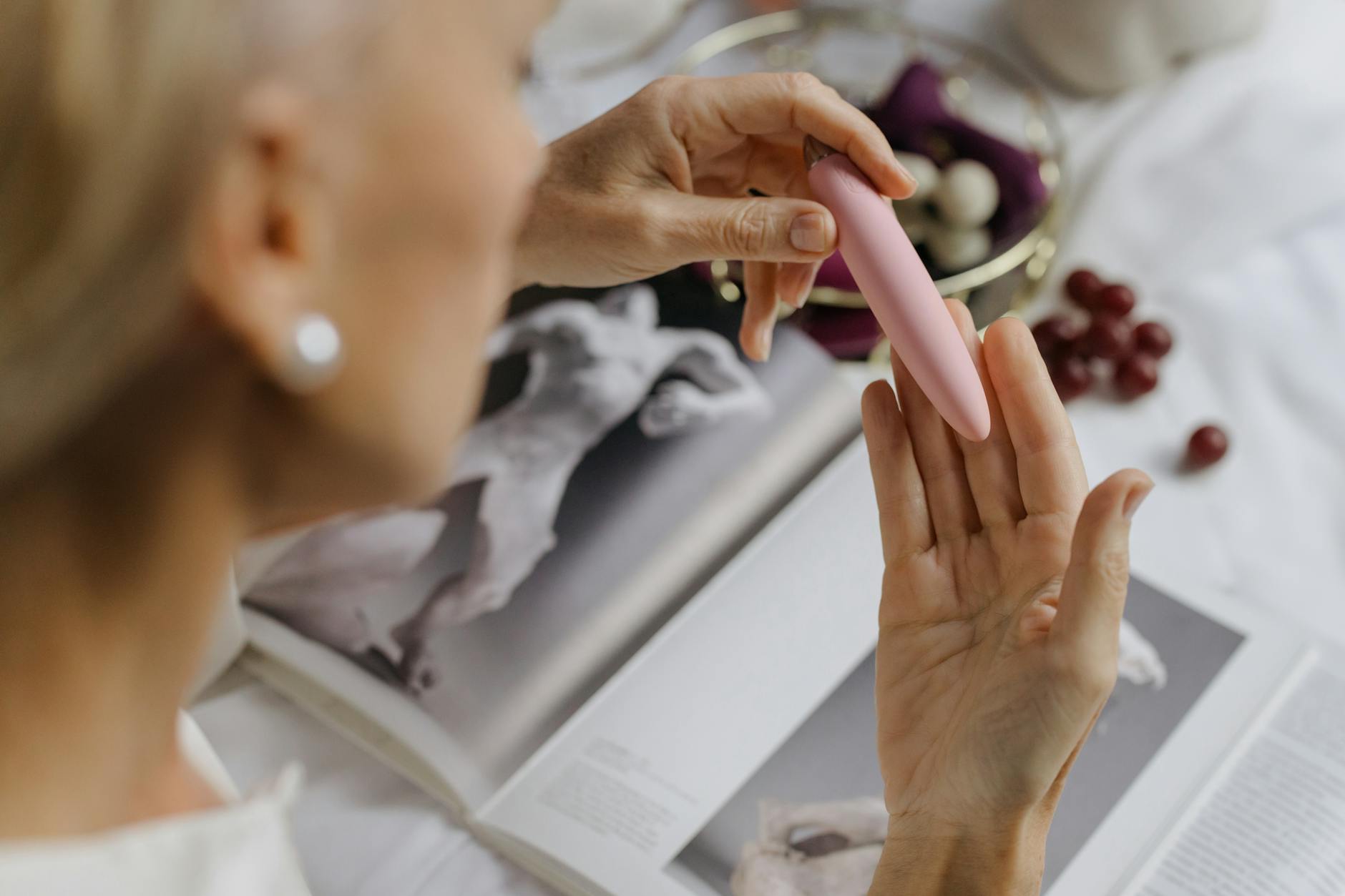
Here's what nobody tells you about perimenopause and pleasure
Perimenopause sneaks up. One day you're fine, the next your body feels like someone else's. Pleasure becomes unpredictable. Your clitoris might feel numb one day and hypersensitive the next. Arousal takes forever to build. Or it builds and then just. Stops. This isn't normal aging. This is hormonal chaos, and it's temporary, and it's fixable.
The problem is that most conversations about midlife sexuality skip right over perimenopause and land on menopause. But perimenopause is the real inflection point. This is where sensation starts shifting, where the rules of your body change, and where most people panic instead of adapting.
Let me be direct: using a lemon vibrator during perimenopause isn't about working around a problem. It's about meeting your body where it actually is right now.
What's actually happening to your nervous system
Estrogen doesn't just affect tissue thickness. It affects how your nerves transmit sensation. During perimenopause, estrogen levels are doing a weird dance. They spike and crash unpredictably. Some days you have plenty. Other days you're running on fumes. Your clitoral nerves are sensitive to these shifts, which means your capacity to feel pleasure becomes inconsistent.
At the same time, progesterone is dropping, which affects your brain's ability to register pleasure signals. Your arousal circuits are getting mixed messages. The physical sensation might be there, but the brain isn't picking it up cleanly. This is why you might touch yourself or have your partner touch you and feel almost nothing, even though you want to feel something.
Adding complexity: the ligaments supporting your clitoris have less collagen support as estrogen drops. This means the angle of arousal changes slightly. Things that felt amazing at 35 might feel uncomfortable at 48. You're not broken. Your anatomy has just shifted.
Clitoral vibrators, especially ones designed with precision like lemon vibrators, bypass some of this friction. They work because they send strong, consistent neural signals that don't depend on your current hormone levels the way touch does. The sensation pattern is stable even when your body isn't.
Why lemon vibrators work better than your partner's hands right now
I know that sounds blunt. But it's not romantic realism. It's science.
Your partner's touch is variable. Pressure changes. Speed changes. Timing changes. Your partner's also probably approaching you the same way they did five years ago, which worked then but doesn't work now. During perimenopause, your nervous system needs consistency and precision. You need stimulation that doesn't require you to give feedback or adjust. You need a tool that stays the same so you can focus on what's actually happening inside your body.
Lemon vibrators deliver this. The sensation is predictable, which allows your nervous system to relax and actually register pleasure. You're not wondering if the pressure is right or if you should ask for more. You're just feeling.
That said, this doesn't mean your partner vanishes. But the job description changes. Their role becomes support, not primary stimulation. They can be present, can touch your body somewhere else, can be engaged in the experience without being the sole source of sensation. Many couples find this actually deepens intimacy because it removes the pressure to perform.
The setup that actually works for perimenopause bodies
Three things matter more right now than they did five years ago.
First, lubrication is non-negotiable. Estrogen affects mucous membrane thickness. Your natural lubrication might be lighter now, or it might take longer to arrive. Water-based lubricant isn't a sign of dysfunction. It's a practical tool. Use it generously. Silicone lubes feel richer, but they can damage silicone toys like the lemon clitoral vibrator, so stick with water-based. Reapply as you go. This single shift often makes the difference between sensation feeling muted and feeling vivid.
Second, extend your warm-up time. Arousal during perimenopause requires more buildup. Your body isn't being lazy. Estrogen affects blood flow to your genitals, which means engorgement takes longer. Budget 20 to 30 minutes before you even turn on your vibrator. This might mean skin-to-skin time, manual exploration, or just lying with your partner. Let your body actually transition into arousal mode. Jumping straight to the vibrator when you're not aroused is like starting a car in subzero weather. It works, but it's not efficient.
Third, start low and work up. The sensitivity of your clitoris during perimenopause is erratic. Some days you can handle high intensity. Other days even medium vibration feels too much. Always start at pattern 1 or 2 on your lemon vibrator. Let your body tell you what it needs. You can always turn it up. You can't undo oversensitivity mid-session.
The positioning shift that changes everything
This is subtle but important. Your clitoris might have shifted slightly in how it sits in your body. The angle that felt perfect at 40 might be uncomfortable at 48.
Instead of approaching your clitoris straight-on, try angling the vibrator. Some people find that coming at it from slightly above or below the clitoral head works better than direct contact. Others find that the suction sensation of devices like the lemon clitoral vibrator feels better than vibration alone because it engages deeper nerve clusters that aren't as affected by estrogen fluctuations.
Experiment without pressure. You're not trying to achieve anything right now. You're gathering data about what your body actually responds to. This is information-gathering, not performance. The difference matters.
When to work with a partner and when to work alone
Let's be real. Sometimes the most accessible pleasure during perimenopause comes from solo exploration. Your body's demands are changing faster than a partner can keep up with. You're learning new rhythms. Having someone else in the experience can add pressure.
That's not a referendum on your relationship. It's a practical choice. Give yourself 2 to 3 weeks of solo time with your lemon vibrator. Learn what works. Find your new baseline. Then bring your partner in, and you'll have specific language for what feels good.
If you do involve a partner right away, tell them explicitly: "My body is changing right now, and I need us to slow down and experiment together." Most partners respond well when they understand that this isn't about them. It's about your nervous system recalibrating.
The mental piece that's actually more important than the physical piece
Here's what I see clinically. People in perimenopause often assume that if pleasure doesn't happen immediately and effortlessly the way it used to, something is wrong with them. This belief becomes a barrier. You tense up. You stop exploring. You decide you're broken and check out.
That's when pleasure actually disappears.
Pleasure during perimenopause requires permission. Permission to take longer. Permission to need different tools. Permission for your body to be different than it was. This isn't resignation. It's adaptation. And adaptation is where pleasure actually gets richer.
When you use a lemon vibrator during this transition, you're not hiding from aging. You're actively choosing pleasure despite the biological shifts happening. That choice matters more than the vibration itself.
The timeline: when sensation usually returns
Don't panic if it takes a few weeks. Your nervous system is adjusting. Some people feel significant sensation shifts within 2 to 3 weeks of consistent exploration with a lemon vibrator. Others take 6 to 8 weeks. Both are normal.
What matters is consistency. Using your vibrator once and then giving up won't tell you anything. Your body needs repetition to recalibrate. Think of it like physical therapy for your nervous system. You're teaching your clitoris and your brain how to communicate again in a new way.
Most people report that after 4 to 6 weeks of regular use, sensation doesn't just return. It often feels deeper and more interesting than it did before perimenopause. Not because the vibrator is magic. Because you've learned to pay actual attention to your body instead of assuming arousal would just happen on its own.
FAQ: What people actually need to know
Is it normal for pleasure to feel so different in your 40s and 50s?
Completely normal. Pleasure doesn't stay static your whole life. Hormonal shifts, nervous system changes, relationship dynamics, stress, medications, health shifts. All of this affects how sensation registers. The mistake is thinking that different means broken. Different means your body needs different tools, which is fine. You adapted to other changes in your life. You can adapt to this one.
Will using a lemon vibrator make partner sex less satisfying?
No. This is a common fear, and it's not supported by research. Actually, the opposite tends to happen. When you know how your body works and what brings you pleasure, you can communicate that to your partner more clearly. You're not less interested in partner sex. You're more informed about what works. That usually improves things.
Can I use lemon vibrators if I'm on hormone therapy or medication?
Yes, and often especially helpful. If you're on HRT, pleasure might feel chaotic during the adjustment phase. Your body is stabilizing. Lemon vibrators can be a consistent tool while your hormones settle. If you're on medications that affect sensation (like some antidepressants), clitoral vibrators often work better than manual stimulation specifically because they provide stronger neural signals. Talk to your doctor if you have specific concerns, but vibrators are generally safe alongside medical treatment.
What if I feel numb even with a vibrator?
Try these in order: increase warm-up time, use more lubrication, start at lower intensity and build slower, angle the vibrator differently, try a different vibrator pattern. If numbness persists after 4 to 6 weeks despite these adjustments, it's worth mentioning to your doctor. Sometimes medication side effects or underlying conditions need addressing. But give your body time first.
Should I tell my partner I'm using a lemon vibrator?
Yes, eventually. Not necessarily right away. Use it alone first, figure out what works, then bring your partner in with specific information. "I've been exploring, and here's what I've learned about my body right now." That's a much stronger conversation than "I need a vibrator because you're not enough." Frame it as expanded options, not replacement.
Is perimenopause pleasure different permanently or just temporarily?
Both. Some shifts are permanent. Your body after perimenopause isn't identical to your body before. But the acute chaos usually stabilizes. Within 6 to 12 months after your last period, things settle. You'll have your new normal. And most people find their new normal is actually pretty good, especially once they stop fighting it and start working with it.
The actual truth about perimenopause and pleasure
Your body isn't broken. It's changing. And change isn't a dead end. It's a redirect.
Lemon vibrators work during this transition not because they're magic, but because they meet you where you actually are instead of where you used to be. They're consistent. They're precise. They don't require your body to perform on old rules.
Use them without shame. Talk about what you're learning. Give your body time. Be curious instead of critical. And trust that pleasure isn't ending. It's just redecorating.
If you want to explore more about navigating intimacy during major life transitions, how lemon vibrators help rebuild pleasure after years of partner routine covers similar ground from a different angle. You might also find how to use a lemon vibrator when arousal takes longer to build helpful, since that's often the biggest complaint during perimenopause.
Your body is not your enemy. It's just saying hello in a new language. Learn to listen.